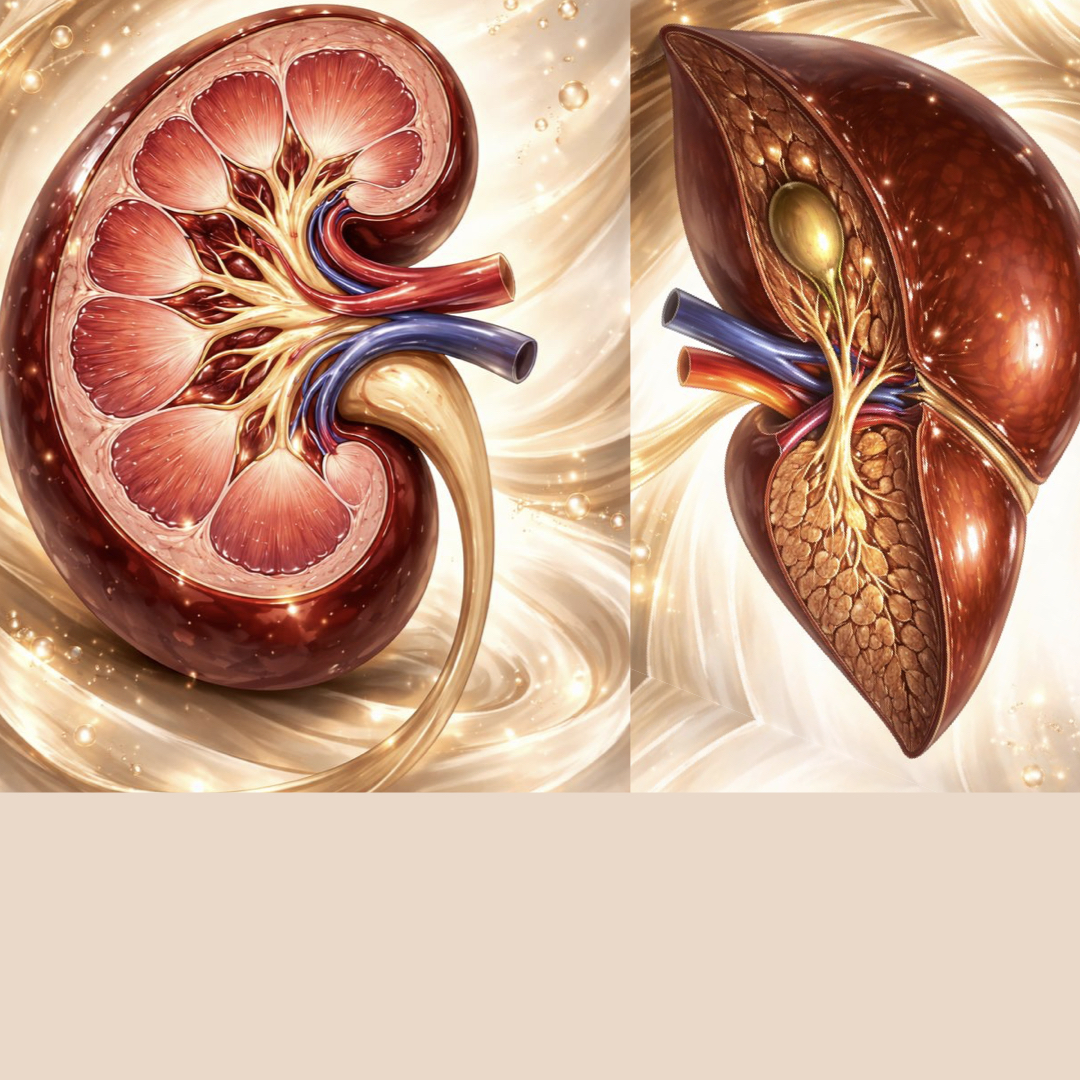
Dessins d’un rein et d’un foie par ChatGPT en grande forme !!!
Traduction de cet article sur demande.
How PFAS are “integrated” by tissues (mechanistic view)
1) Delivery in blood: strong binding to proteins
Many widely studied PFAS (notably PFOS and long-chain PFCAs) circulate largely bound to plasma proteins (e.g., albumin) and other binding proteins, which strongly influences where they go and how long they stay. This is a major reason blood and liver often track exposure well and why PFAS are typically not highest in fat (unlike many organochlorines). American Chemical Society Publications+1
2) Crossing into organs: transporters > diffusion
PFAS do not rely primarily on simple passive diffusion; multiple studies and reviews point to membrane transporters as key determinants of uptake into (and removal from) tissues—especially liver and kidney. Transporter families implicated include organic anion transporting polypeptides (OATPs) and related systems that can move certain PFAS across cell membranes. PMC+1
3) Retention patterns: liver, blood, kidney dominate
Across taxa, a common pattern is highest concentrations in liver, then blood and kidney, with lowest in adipose. This aligns with protein binding + hepatic/renal handling rather than fat partitioning. PubMed+2American Chemical Society Publications+2
4) Persistence mechanisms: renal reabsorption + enterohepatic cycling
Two processes often emphasized for persistence are:
- Kidney handling (filtration followed by tubular reabsorption/active transport, which slows elimination).
- Biliary excretion with reabsorption (enterohepatic recirculation), which can effectively recycle PFAS back to blood.
(These mechanisms are consistently discussed in authoritative risk/ADME syntheses and transporter-focused reviews.) Actu Environnement+1
Why PFAS can rise in blood during long fasting (and what “release” really means)
When animals fast for weeks to months, the key change is a shift in body composition and physiology that changes PFAS distribution and apparent concentrations:
A) Concentration effects (less “dilution”)
Fasting can reduce body mass and alter plasma volume and protein pools. If the amount of PFAS in the body changes slowly (because PFAS are persistent) while the distribution volume shrinks, measured plasma concentrations can rise even without new exposure. This effect is specifically observed in field fasting contexts. PubMed+1
B) Mobilization of protein-rich compartments (not fat)
Because many PFAS are protein-associated, catabolism/mobilization of lean/protein compartments and circulating proteins can increase PFAS availability in blood. This differs from lipophilic pollutants that spike mainly with fat mobilization. LIENSs+2Archimer+2
C) Changed hepatic and renal fluxes
Fasting can alter liver metabolism, bile flow, kidney filtration and tubular transport, potentially shifting PFAS clearance versus recycling. The net effect can be higher circulating PFAS during fasting in some species/contexts. PMC+1
D) Tissue redistribution and “toxic potential” during emaciation
Work in Arctic mammals emphasizes that body condition influences tissue distribution and that seasonal emaciation can increase toxicological concern via redistribution (and/or higher circulating levels), even if total body burden is stable. PubMed+1
What the wildlife literature says for three focal cases
King penguins (long-term fast)
A 2024 study quantified plasma PFAS kinetics across ~25 days of fasting in wild king penguins (molting vs. breeding/courtship fasts), explicitly using the natural long fast as a toxicokinetic “experiment.” The paper reports systematic changes in blood PFAS concentrations during the fast, consistent with redistribution/concentration effects under different metabolic strategies. LIENSs+1
Polar bears (feeding vs fasting)
A well-cited polar bear study reported that PFAS concentrations (including PFSAs and C8–C10 PFCAs) were higher in fasting than feeding bears in the sampled population(s), linking circulating PFAS patterns to metabolic state and diet. PubMed+1
Arctic fox (body condition and tissue distribution)
Aas et al. (2014) examined how body condition affects PFAS tissue distribution in Arctic foxes (liver, blood, kidney, adipose, muscle). They report highest burdens in liver/blood/kidney and discuss that seasonal emaciation can increase toxic potential, reinforcing the “condition-dependent redistribution” concept. PubMed+1
Practical framing for “release during fasting”
If you need a single mechanistic sentence suitable for a paper or slide:
During prolonged fasting, PFAS are bound to proteins and undergo condition-dependent redistribution and apparent concentration increases as plasma/lean compartments contract and hepatic–renal transport and recirculation fluxes shift, yielding higher circulating levels in fasting states. PubMed+2LIENSs+2
If you tell me which PFAS class you care about most (PFOS/PFOA vs. long-chain PFCAs vs. precursors like FOSA), I can map the above to expected tissue ranking, fasting directionality, and the most relevant transporters for that subset.
1. Why urine is not a major PFAS elimination route
A) Strong renal reabsorption dominates
Most environmentally relevant PFAS (PFOS, long-chain PFCAs such as C8–C12) are:
- Freely or partially filtered at the glomerulus
- Actively reabsorbed in renal tubules via organic anion transporters (e.g., OATs, OATPs, possibly URAT-like systems)
As a result, net urinary clearance is very low, which is the principal reason for long biological half-lives in mammals (years in humans; months to years in wildlife).
This means:
- Urine PFAS concentrations are orders of magnitude lower than plasma
- Urinary excretion is not proportional to body burden
2. What prolonged fasting changes in the kidney
Prolonged fasting (weeks to months) induces several physiological changes that are directly relevant to PFAS handling:
A) Reduced glomerular filtration rate (GFR)
Fasting and dehydration often lead to:
- Lower renal perfusion
- Reduced GFR
- Concentrated urine with lower total solute flux
Lower GFR → less PFAS filtered into primary urine.
B) Enhanced tubular reabsorption efficiency
During fasting:
- The kidney upregulates solute and water conservation
- Tubular transport systems become more efficient
For PFAS, this typically means:
- Higher fractional reabsorption
- Lower net urinary loss, even if plasma PFAS concentrations rise
Thus, paradoxically, higher blood PFAS during fasting does not translate into higher urinary elimination.
C) Plasma protein binding limits filtration
Because most PFAS are:
- Strongly bound to albumin and other plasma proteins
Only the unbound fraction can be filtered.
During fasting:
- Albumin concentration may increase (hemoconcentration)
- Free PFAS fraction may decrease or remain constrained
This further limits urinary appearance.
3. Observations from wildlife and experimental contexts
Penguins (long natural fasts)
- Urine/feces are not major PFAS elimination routes during molt or incubation fasts
- PFAS are instead conserved and redistributed internally
- Plasma PFAS may increase while excretory flux approaches zero
Urinary PFAS has rarely been reported in penguins precisely because it is analytically low and biologically marginal during fasting.
Polar bears
- Field studies emphasize plasma and liver, not urine
- Fasting bears show elevated circulating PFAS, consistent with:
- Reduced elimination
- Continued renal reabsorption
- No evidence that fasting enhances urinary clearance
Arctic fox
- Body-condition studies show redistribution among liver, blood, kidney
- Kidney acts as a retention organ, not an elimination pathway
- Urinary loss during emaciation is inferred to be minimal
4. When PFAS do appear more in urine
There are exceptions, which help clarify the mechanism:
A) Short-chain PFAS
Shorter-chain PFAS (e.g., PFBA, PFHxA):
- Bind plasma proteins less strongly
- Are reabsorbed less efficiently
- Show higher urinary excretion, even during caloric restriction
These behave differently from PFOS or long-chain PFCAs.
B) Refeeding after fasting
Refeeding can transiently increase urinary PFAS because:
- GFR increases
- Tubular transporter balance shifts
- Bile flow and enterohepatic cycling change
Thus, post-fast refeeding, not fasting itself, may be a window of increased elimination.
 PFAS in Lyon